Choose a Familiar Walking Route by Access, Surface and a Clear Turnaround
A practical route check can make an ordinary walking plan easier to follow. Consider surface, crossings, access and a clear option to turn back. This is local activity planning rather than a travel itinerary or a personalized exercise prescription.
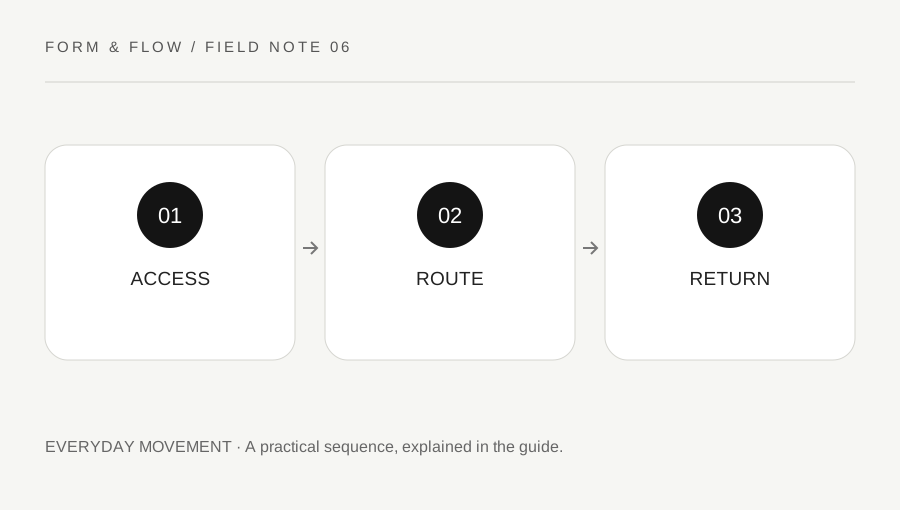
Original explanatory diagram. Examples illustrate a method or decision; they are not claims of personal testing.
Start with a known setting
Choose a location you understand or obtain current local information before relying on it. Check entrances, opening times, accessible paths and any relevant site rules. A route shown on a map may not reveal construction, closures or a difficult surface.
Match the setting to your abilities and appropriate activity guidance. Do not infer suitability from another person's description of easy. A flat paved path, uneven trail and crowded street have different demands. For individual health or mobility questions, obtain suitable advice rather than using a general route label as clearance.
Inspect practical interruptions
Identify road crossings, narrow sections, stairs and places where you can pause appropriately. Consider lighting and current weather. Follow local safety guidance and do not use a route whose conditions exceed the plan or equipment you have.
Keep a clear return option. An out-and-back route can be simple to understand, but its suitability still depends on the setting. Do not choose a distance merely to match an online target. The plan should remain adaptable if conditions or your circumstances change.
Prepare the useful essentials
Use suitable footwear and clothing for the actual activity and conditions, following relevant requirements. Carry necessary personal items without overloading a bag. If you use audio, retain appropriate awareness of the environment and consider safe listening practices.
Let the route plan describe access and organization, not a guarantee of physical benefit. A general article cannot determine a safe duration or pace for every reader. Use the activity level and guidance appropriate to your circumstances, and stop if you feel unwell or pain occurs.
Work through a local comparison
Imagine comparing a familiar park loop with a busy street route. The park may offer fewer crossings but have an access gate or uneven section; the street may have a smooth surface but more traffic interactions. Check the actual conditions rather than assuming the park is automatically the better choice.
Choose the route whose practical demands fit the plan and note a clear turnaround or exit. Keep the first check modest. A route can be rejected because access is unclear even when it looks attractive on a map.
Record what changed on the day
After an actual walk, note closures, surface conditions and whether the return arrangement worked. Keep private location and schedule details out of public screenshots. Do not publish a route as universally accessible without appropriate verified information.
Use the record to choose a suitable repeat or another local option. The purpose is a dependable setting for appropriate activity, not a competition over distance or pace. Broad public guidance can frame activity choices, while current local conditions and individual needs determine the route you actually use.
Make a route card with access point, current surface information, crossings, a pause option and a clear return decision. Keep any contact or personal information private. If a public source says a path is accessible, read what that statement actually covers and verify current conditions where necessary. A gate closure or temporary works can change an otherwise familiar route. After a real visit, record the date of the observation rather than publishing it as permanently current. This makes the card useful for local planning while avoiding a universal accessibility promise or a distance target detached from individual circumstances.
A practical checklist
Choices are saved in this browser. Reset them here or clear this site’s browser storage.
Questions that come up
Does easy on a map mean suitable for me?
No. Labels can omit surface, access and individual demands. Check current local information and your own appropriate guidance.
Must I complete the whole route?
Keep a clear option to change or stop the plan. Do not treat a mapped loop as an obligation when conditions or circumstances change.
Is this a training-distance prescription?
No. It is a practical route-check framework. Appropriate duration and intensity depend on the person and relevant guidance.
References & scope
Background references checked on 18 October 2026. Worked examples and diagrams are original teaching material.